Tim Brooks* Aleksander Holynski* Alexei A. Efros
University of California, Berkeley
Abstract
We propose a method for editing images from human instructions: given an input image and a written instruction that tells the model what to do, our model follows these instructions to edit the image. To obtain training data for this problem, we combine the knowledge of two large pretrained models—a language model (GPT-3) and a text-to-image model (Stable Diffusion)—to generate a large dataset of image editing examples. Our conditional diffusion model, InstructPix2Pix, is trained on our generated data, and generalizes to real images and user-written instructions at inference time. Since it performs edits in the forward pass and does not require per-example fine-tuning or inversion, our model edits images quickly, in a matter of seconds. We show compelling editing results for a diverse collection of input images and written instructions.
0
![[Uncaptioned image]](https://ar5iv.labs.arxiv.org/html/2211.09800/assets/x1.png)
Figure 1: Given an image and an instruction for how to edit that image, our model performs the appropriate edit. Our model does not require full descriptions for the input or output image, and edits images in the forward pass without per-example inversion or fine-tuning.
1 Introduction
We present a method for teaching a generative model to follow human-written instructions for image editing. Since training data for this task is difficult to acquire at scale, we propose an approach for generating a paired dataset that combines multiple large models pretrained on different modalities: a large language model (GPT-3 1) and a text-to-image model (Stable Diffusion 2). These two models capture complementary knowledge about language and images that can be combined to create paired training data for a task spanning both modalities.
Using our generated paired data, we train a conditional diffusion model that, given an input image and a text instruction for how to edit it, generates the edited image. Our model directly performs the image edit in the forward pass, and does not require any additional example images, full descriptions of the input/output images, or per-example finetuning. Despite being trained entirely on synthetic examples (i.e., both generated written instructions and generated imagery), our model achieves zero-shot generalization to both arbitrary real images and natural human-written instructions. Our model enables intuitive image editing that can follow human instructions to perform a diverse collection of edits: replacing objects, changing the style of an image, changing the setting, the artistic medium, among others. Selected examples can be found in Figure 1.
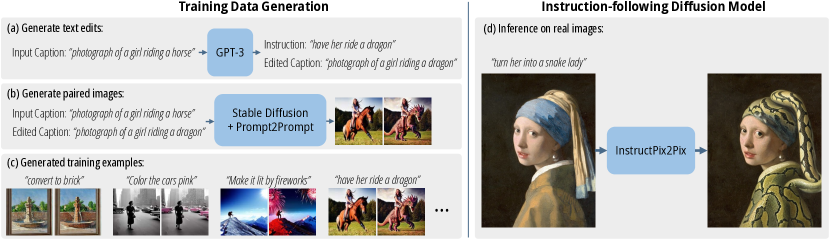
Figure 2: Our method consists of two parts: generating an image editing dataset, and training a diffusion model on that dataset. (a) We first use a finetuned GPT-3 to generate instructions and edited captions. (b) We then use StableDiffusion 52 in combination with Prompt-to-Prompt 17 to generate pairs of images from pairs of captions. We use this procedure to create a dataset (c) of over 450,000 training examples. (d) Finally, our InstructPix2Pix diffusion model is trained on our generated data to edit images from instructions. At inference time, our model generalizes to edit real images from human-written instructions.
2 Prior work
Composing large pretrained models
Recent work has shown that large pretrained models can be combined to solve multimodal tasks that no one model can perform alone, such as image captioning and visual question answering (tasks that require the knowledge of both a large language model and a text-image model). Techniques for combining pretrained models include joint finetuning on a new task 3 4 5 6, communication through prompting 7 8, composing probability distributions of energy-based models 9 10, guiding one model with feedback from another 11, and iterative optimization 12. Our method is similar to prior work in that it leverages the complementary abilities of two pretrained models—GPT-3 1) and Stable Diffusion 2 —but differs in that we use these models to generate paired multi-modal training data.
Diffusion-based generative models
Recent advances in diffusion models 13 have enabled state-of-the-art image synthesis 14 15 16 17 18 19 as well as generative models of other modalities such as video 20 21, audio 22, text 23 and network parameters 24. Recent text-to-image diffusion models 25 2 26 27 have shown to generate realistic images from arbitrary text captions.
Generative models for image editing
Image editing models traditionally targeted a single editing task such as style transfer 28 29 or translation between image domains 30 31 32 33 34. Numerous editing approaches invert 35 36 37 38 or encode 39 40 41 images into a latent space (e.g., StyleGAN 42 43) where they can be edited by manipulating latent vectors. Recent models have leveraged CLIP 44 embeddings to guide image editing using text 45 46 47 48 25 49 50 51. We compare with one of these methods, Text2Live 52, an editing method that optimizes for an additive image layer that maximizes a CLIP similarity objective.
Recent works have used pretrained text-to-image diffusion models for image editing 53 54 50 26 55. While some text-to-image models natively have the ability to edit images (e.g., DALLE-2 can create variations of images, inpaint regions, and manipulate the CLIP embedding 26), using these models for targeted editing is non-trivial, because in most cases they offer no guarantees that similar text prompts will yield similar images. Recent work by Hertz et al. 55 tackles this issue with Prompt-to-Prompt, a method for assimilating the generated images for similar text prompts, such that isolated edits can be made to a generated image. We use this method in generating training data. To edit non-generated (i.e., real) imagery, SDEdit 53 uses a pretrained model to noise and denoise an input image with a new target prompt. We compare with SDEdit as a baseline. Other recent works perform local inpainting given a caption and user-drawn mask 26 50, generate new images of a specific object or concept learned from a small collection of images 56 57, or perform editing by inverting (and fine-tuning) a single image, and subsequently regenerating with a new text description 54. In contrast to these approaches, our model takes only a single image and an instruction for how to edit that image (i.e., not a full description of any image), and performs the edit directly in the forward pass without need for a user-drawn mask, additional images, or per-example inversion or finetuning.
Learning to follow instructions
Our method differs from existing text-based image editing works 53 57 56 55 54 52 in that it enables editing from instructions that tell the model what action to perform, as opposed to text labels, captions or descriptions of input/output images. A key benefit of following editing instructions is that the user can just tell the model exactly what to do in natural written text. There is no need for the user to provide extra information, such as example images or descriptions of visual content that remains constant between the input and output images. Instructions are expressive, precise, and intuitive to write, allowing the user to easily isolate specific objects or visual attributes to change. Our goal to follow written image editing instructions is inspired by recent work teaching large language models to better follow human instructions for language tasks 58 59 60.
Training data generation with generative models
Deep models typically require large amounts of training data. Internet data collections are often suitable, but may not exist in the form necessary for supervision, e.g., paired data of particular modalities. As generative models continue to improve, there is growing interest in their use as a source of cheap and plentiful training data for downstream tasks 61 62 63 64 65 66. In this paper, we use two different off-the-shelf generative models (language, text-to-image) to produce training data for our editing model.
3 Method
We treat instruction-based image editing as a supervised learning problem: (1) first, we generate a paired training dataset of text editing instructions and images before/after the edit (Sec. 3.1, Fig. 2a-c), then (2) we train an image editing diffusion model on this generated dataset (Sec. 3.2, Fig 2d). Despite being trained with generated images and editing instructions, our model is able to generalize to editing real images using arbitrary human-written instructions. See Fig. 2 for an overview of our method.
3.1 Generating a Multi-modal Training Dataset
We combine the abilities of two large-scale pretrained models that operate on different modalities—a large language model 1 and a text-to-image model 2 —to generate a multi-modal training dataset containing text editing instructions and the corresponding images before and after the edit. In the following two sections, we describe in detail the two steps of this process. In Section 3.1.1, we describe the process of fine-tuning GPT-3 1 to generate a collection of text edits: given a prompt describing an image, produce a text instruction describing a change to be made and a prompt describing the image after that change (Figure 2a). Then, in Section 3.1.2, we describe the process of converting the two text prompts (i.e., before and after the edit) into a pair of corresponding images using a text-to-image model 2 (Figure 2b).
3.1.1 Generating Instructions and Paired Captions

Table 1: We label a small text dataset, finetune GPT-3, and use that finetuned model to generate a large dataset of text triplets. As the input caption for both the labeled and generated examples, we use real image captions from LAION. Highlighted text is generated by GPT-3.
Footnotes
-
Tom Brown, Benjamin Mann, Nick Ryder, Melanie Subbiah, Jared D Kaplan, Prafulla Dhariwal, Arvind Neelakantan, Pranav Shyam, Girish Sastry, Amanda Askell, et al. Language models are few-shot learners. Advances in neural information processing systems, 33:1877–1901, 2020. ↩ ↩2 ↩3 ↩4
-
Robin Rombach, Andreas Blattmann, Dominik Lorenz, Patrick Esser, and Björn Ommer. High-resolution image synthesis with latent diffusion models. In Proceedings of the IEEE/CVF Conference on Computer Vision and Pattern Recognition, pages 10684–10695, 2022. ↩ ↩2 ↩3 ↩4 ↩5
-
Jean-Baptiste Alayrac, Jeff Donahue, Pauline Luc, Antoine Miech, Iain Barr, Yana Hasson, Karel Lenc, Arthur Mensch, Katie Millican, Malcolm Reynolds, et al. Flamingo: a visual language model for few-shot learning. arXiv preprint arXiv:2204.14198, 2022. ↩
-
Ron Mokady, Amir Hertz, and Amit H Bermano. Clipcap: Clip prefix for image captioning. arXiv preprint arXiv:2111.09734, 2021. ↩
-
Zirui Wang, Jiahui Yu, Adams Wei Yu, Zihang Dai, Yulia Tsvetkov, and Yuan Cao. Simvlm: Simple visual language model pretraining with weak supervision. arXiv preprint arXiv:2108.10904, 2021. ↩
-
Liunian Harold Li, Mark Yatskar, Da Yin, Cho-Jui Hsieh, and Kai-Wei Chang. Visualbert: A simple and performant baseline for vision and language. arXiv preprint arXiv:1908.03557, 2019. ↩
-
Andy Zeng, Adrian Wong, Stefan Welker, Krzysztof Choromanski, Federico Tombari, Aveek Purohit, Michael Ryoo, Vikas Sindhwani, Johnny Lee, Vincent Vanhoucke, et al. Socratic models: Composing zero-shot multimodal reasoning with language. arXiv preprint arXiv:2204.00598, 2022. ↩
-
Anthony Meng Huat Tiong, Junnan Li, Boyang Li, Silvio Savarese, and Steven CH Hoi. Plug-and-play vqa: Zero-shot vqa by conjoining large pretrained models with zero training. arXiv preprint arXiv:2210.08773, 2022. ↩
-
Yilun Du, Shuang Li, and Igor Mordatch. Compositional visual generation with energy based models. Advances in Neural Information Processing Systems, 33:6637–6647, 2020. ↩
-
Nan Liu, Shuang Li, Yilun Du, Antonio Torralba, and Joshua B Tenenbaum. Compositional visual generation with composable diffusion models. arXiv preprint arXiv:2206.01714, 2022. ↩
-
Yoad Tewel, Yoav Shalev, Idan Schwartz, and Lior Wolf. Zero-shot image-to-text generation for visual-semantic arithmetic. arXiv preprint arXiv:2111.14447, 2021. ↩
-
Shuang Li, Yilun Du, Joshua B Tenenbaum, Antonio Torralba, and Igor Mordatch. Composing ensembles of pre-trained models via iterative consensus. arXiv preprint arXiv:2210.11522, 2022. ↩
-
Jascha Sohl-Dickstein, Eric Weiss, Niru Maheswaranathan, and Surya Ganguli. Deep unsupervised learning using nonequilibrium thermodynamics. In Francis Bach and David Blei, editors, Proceedings of the 32nd International Conference on Machine Learning, volume 37 of Proceedings of Machine Learning Research, pages 2256–2265, Lille, France, 07–09 Jul 2015. PMLR. ↩
-
Yang Song and Stefano Ermon. Generative modeling by estimating gradients of the data distribution. Advances in Neural Information Processing Systems, 32, 2019. ↩
-
Jonathan Ho, Ajay Jain, and Pieter Abbeel. Denoising diffusion probabilistic models. Advances in Neural Information Processing Systems, 33:6840–6851, 2020. ↩
-
Prafulla Dhariwal and Alexander Nichol. Diffusion models beat gans on image synthesis. Advances in Neural Information Processing Systems, 34:8780–8794, 2021. ↩
-
Jonathan Ho, Chitwan Saharia, William Chan, David J Fleet, Mohammad Norouzi, and Tim Salimans. Cascaded diffusion models for high fidelity image generation. J. Mach. Learn. Res., 23:47–1, 2022. ↩
-
Chitwan Saharia, Jonathan Ho, William Chan, Tim Salimans, David J Fleet, and Mohammad Norouzi. Image super-resolution via iterative refinement. IEEE Transactions on Pattern Analysis and Machine Intelligence, 2022. ↩
-
Chitwan Saharia, William Chan, Huiwen Chang, Chris Lee, Jonathan Ho, Tim Salimans, David Fleet, and Mohammad Norouzi. Palette: Image-to-image diffusion models. In ACM SIGGRAPH 2022 Conference Proceedings, pages 1–10, 2022. ↩
-
Jonathan Ho, Tim Salimans, Alexey Gritsenko, William Chan, Mohammad Norouzi, and David J Fleet. Video diffusion models. arXiv preprint arXiv:2204.03458, 2022. ↩
-
Uriel Singer, Adam Polyak, Thomas Hayes, Xi Yin, Jie An, Songyang Zhang, Qiyuan Hu, Harry Yang, Oron Ashual, Oran Gafni, et al. Make-a-video: Text-to-video generation without text-video data. arXiv preprint arXiv:2209.14792, 2022. ↩
-
Zhifeng Kong, Wei Ping, Jiaji Huang, Kexin Zhao, and Bryan Catanzaro. Diffwave: A versatile diffusion model for audio synthesis. arXiv preprint arXiv:2009.09761, 2020. ↩
-
Xiang Lisa Li, John Thickstun, Ishaan Gulrajani, Percy Liang, and Tatsunori B Hashimoto. Diffusion-lm improves controllable text generation. arXiv preprint arXiv:2205.14217, 2022. ↩
-
William Peebles, Ilija Radosavovic, Tim Brooks, Alexei A Efros, and Jitendra Malik. Learning to learn with generative models of neural network checkpoints. arXiv preprint arXiv:2209.12892, 2022. ↩
-
Alex Nichol, Prafulla Dhariwal, Aditya Ramesh, Pranav Shyam, Pamela Mishkin, Bob McGrew, Ilya Sutskever, and Mark Chen. Glide: Towards photorealistic image generation and editing with text-guided diffusion models. arXiv preprint arXiv:2112.10741, 2021. ↩ ↩2
-
Aditya Ramesh, Prafulla Dhariwal, Alex Nichol, Casey Chu, and Mark Chen. Hierarchical text-conditional image generation with clip latents. arXiv preprint arXiv:2204.06125, 2022. ↩ ↩2 ↩3 ↩4
-
Chitwan Saharia, William Chan, Saurabh Saxena, Lala Li, Jay Whang, Emily Denton, Seyed Kamyar Seyed Ghasemipour, Burcu Karagol Ayan, S Sara Mahdavi, Rapha Gontijo Lopes, et al. Photorealistic text-to-image diffusion models with deep language understanding. arXiv preprint arXiv:2205.11487, 2022. ↩
-
Leon A Gatys, Alexander S Ecker, and Matthias Bethge. A neural algorithm of artistic style. arXiv preprint arXiv:1508.06576, 2015. ↩
-
Leon A Gatys, Alexander S Ecker, and Matthias Bethge. Image style transfer using convolutional neural networks. In Proceedings of the IEEE conference on computer vision and pattern recognition, pages 2414–2423, 2016. ↩
-
Phillip Isola, Jun-Yan Zhu, Tinghui Zhou, and Alexei A Efros. Image-to-image translation with conditional adversarial networks. CVPR, 2017. ↩
-
Jun-Yan Zhu, Taesung Park, Phillip Isola, and Alexei A Efros. Unpaired image-to-image translation using cycle-consistent adversarial networks. In Computer Vision (ICCV), 2017 IEEE International Conference on, 2017. ↩
-
Xun Huang, Ming-Yu Liu, Serge Belongie, and Jan Kautz. Multimodal unsupervised image-to-image translation. In ECCV, 2018. ↩
-
Ming-Yu Liu, Xun Huang, Arun Mallya, Tero Karras, Timo Aila, Jaakko Lehtinen, and Jan Kautz. Few-shot unsupervised image-to-image translation. In IEEE International Conference on Computer Vision (ICCV), 2019. ↩
-
Utkarsh Ojha, Yijun Li, Cynthia Lu, Alexei A. Efros, Yong Jae Lee, Eli Shechtman, and Richard Zhang. Few-shot image generation via cross-domain correspondence. In CVPR, 2021. ↩
-
Rameen Abdal, Yipeng Qin, and Peter Wonka. Image2stylegan: How to embed images into the stylegan latent space? In Proceedings of the IEEE/CVF International Conference on Computer Vision, pages 4432–4441, 2019. ↩
-
Rameen Abdal, Yipeng Qin, and Peter Wonka. Image2stylegan++: How to edit the embedded images? In Proceedings of the IEEE/CVF conference on computer vision and pattern recognition, pages 8296–8305, 2020. ↩
-
Yuval Alaluf, Omer Tov, Ron Mokady, Rinon Gal, and Amit Bermano. Hyperstyle: Stylegan inversion with hypernetworks for real image editing. In Proceedings of the IEEE/CVF Conference on Computer Vision and Pattern Recognition, pages 18511–18521, 2022. ↩
-
Dave Epstein, Taesung Park, Richard Zhang, Eli Shechtman, and Alexei A Efros. Blobgan: Spatially disentangled scene representations. In European Conference on Computer Vision, pages 616–635. Springer, 2022. ↩
-
Omer Tov, Yuval Alaluf, Yotam Nitzan, Or Patashnik, and Daniel Cohen-Or. Designing an encoder for stylegan image manipulation. ACM Transactions on Graphics (TOG), 40(4):1–14, 2021. ↩
-
Elad Richardson, Yuval Alaluf, Or Patashnik, Yotam Nitzan, Yaniv Azar, Stav Shapiro, and Daniel Cohen-Or. Encoding in style: a stylegan encoder for image-to-image translation. In Proceedings of the IEEE/CVF conference on computer vision and pattern recognition, pages 2287–2296, 2021. ↩
-
Lucy Chai, Jonas Wulff, and Phillip Isola. Using latent space regression to analyze and leverage compositionality in gans. In International Conference on Learning Representations, 2021. ↩
-
Tero Karras, Samuli Laine, and Timo Aila. A style-based generator architecture for generative adversarial networks. In Proceedings of the IEEE/CVF conference on computer vision and pattern recognition, pages 4401–4410, 2019. ↩
-
Tero Karras, Samuli Laine, Miika Aittala, Janne Hellsten, Jaakko Lehtinen, and Timo Aila. Analyzing and improving the image quality of stylegan. In Proceedings of the IEEE/CVF conference on computer vision and pattern recognition, pages 8110–8119, 2020. ↩
-
Alec Radford, Jong Wook Kim, Chris Hallacy, Aditya Ramesh, Gabriel Goh, Sandhini Agarwal, Girish Sastry, Amanda Askell, Pamela Mishkin, Jack Clark, et al. Learning transferable visual models from natural language supervision. In International Conference on Machine Learning, pages 8748–8763. PMLR, 2021. ↩
-
Gihyun Kwon and Jong Chul Ye. Clipstyler: Image style transfer with a single text condition. In Proceedings of the IEEE/CVF Conference on Computer Vision and Pattern Recognition, pages 18062–18071, 2022. ↩
-
Or Patashnik, Zongze Wu, Eli Shechtman, Daniel Cohen-Or, and Dani Lischinski. Styleclip: Text-driven manipulation of stylegan imagery. In Proceedings of the IEEE/CVF International Conference on Computer Vision (ICCV), pages 2085–2094, October 2021. ↩
-
Wanfeng Zheng, Qiang Li, Xiaoyan Guo, Pengfei Wan, and Zhongyuan Wang. Bridging clip and stylegan through latent alignment for image editing. arXiv preprint arXiv:2210.04506, 2022. ↩
-
Rinon Gal, Or Patashnik, Haggai Maron, Amit H Bermano, Gal Chechik, and Daniel Cohen-Or. Stylegan-nada: Clip-guided domain adaptation of image generators. ACM Transactions on Graphics (TOG), 41(4):1–13, 2022. ↩
-
Gwanghyun Kim, Taesung Kwon, and Jong Chul Ye. Diffusionclip: Text-guided diffusion models for robust image manipulation. In Proceedings of the IEEE/CVF Conference on Computer Vision and Pattern Recognition, pages 2426–2435, 2022. ↩
-
Omri Avrahami, Dani Lischinski, and Ohad Fried. Blended diffusion for text-driven editing of natural images. In Proceedings of the IEEE/CVF Conference on Computer Vision and Pattern Recognition, pages 18208–18218, 2022. ↩ ↩2 ↩3
-
Katherine Crowson, Stella Biderman, Daniel Kornis, Dashiell Stander, Eric Hallahan, Louis Castricato, and Edward Raff. Vqgan-clip: Open domain image generation and editing with natural language guidance. In European Conference on Computer Vision, pages 88–105. Springer, 2022. ↩
-
Omer Bar-Tal, Dolev Ofri-Amar, Rafail Fridman, Yoni Kasten, and Tali Dekel. Text2live: Text-driven layered image and video editing. In European Conference on Computer Vision, pages 707–723. Springer, 2022. ↩ ↩2
-
Chenlin Meng, Yutong He, Yang Song, Jiaming Song, Jiajun Wu, Jun-Yan Zhu, and Stefano Ermon. Sdedit: Guided image synthesis and editing with stochastic differential equations. In International Conference on Learning Representations, 2021. ↩ ↩2 ↩3
-
Bahjat Kawar, Shiran Zada, Oran Lang, Omer Tov, Huiwen Chang, Tali Dekel, Inbar Mosseri, and Michal Irani. Imagic: Text-based real image editing with diffusion models. arXiv preprint arXiv:2210.09276, 2022. ↩ ↩2 ↩3
-
Amir Hertz, Ron Mokady, Jay Tenenbaum, Kfir Aberman, Yael Pritch, and Daniel Cohen-Or. Prompt-to-prompt image editing with cross attention control. arXiv preprint arXiv:2208.01626, 2022. ↩ ↩2 ↩3
-
Rinon Gal, Yuval Alaluf, Yuval Atzmon, Or Patashnik, Amit H Bermano, Gal Chechik, and Daniel Cohen-Or. An image is worth one word: Personalizing text-to-image generation using textual inversion. arXiv preprint arXiv:2208.01618, 2022. ↩ ↩2
-
Nataniel Ruiz, Yuanzhen Li, Varun Jampani, Yael Pritch, Michael Rubinstein, and Kfir Aberman. Dreambooth: Fine tuning text-to-image diffusion models for subject-driven generation. arXiv preprint arXiv:2208.12242, 2022. ↩ ↩2
-
Long Ouyang, Jeff Wu, Xu Jiang, Diogo Almeida, Carroll L Wainwright, Pamela Mishkin, Chong Zhang, Sandhini Agarwal, Katarina Slama, Alex Ray, et al. Training language models to follow instructions with human feedback. arXiv preprint arXiv:2203.02155, 2022. ↩
-
Swaroop Mishra, Daniel Khashabi, Chitta Baral, and Hannaneh Hajishirzi. Cross-task generalization via natural language crowdsourcing instructions. arXiv preprint arXiv:2104.08773, 2021. ↩
-
Jason Wei, Maarten Bosma, Vincent Y Zhao, Kelvin Guu, Adams Wei Yu, Brian Lester, Nan Du, Andrew M Dai, and Quoc V Le. Finetuned language models are zero-shot learners. arXiv preprint arXiv:2109.01652, 2021. ↩
-
Ashish Shrivastava, Tomas Pfister, Oncel Tuzel, Joshua Susskind, Wenda Wang, and Russell Webb. Learning from simulated and unsupervised images through adversarial training. In Proceedings of the IEEE conference on computer vision and pattern recognition, pages 2107–2116, 2017. ↩
-
Suman Ravuri and Oriol Vinyals. Classification accuracy score for conditional generative models. Advances in neural information processing systems, 32, 2019. ↩
-
Yuri Viazovetskyi, Vladimir Ivashkin, and Evgeny Kashin. Stylegan2 distillation for feed-forward image manipulation. In European conference on computer vision, pages 170–186. Springer, 2020. ↩
-
Nontawat Tritrong, Pitchaporn Rewatbowornwong, and Supasorn Suwajanakorn. Repurposing gans for one-shot semantic part segmentation. In Proceedings of the IEEE/CVF conference on computer vision and pattern recognition, pages 4475–4485, 2021. ↩
-
Daiqing Li, Huan Ling, Seung Wook Kim, Karsten Kreis, Sanja Fidler, and Antonio Torralba. Bigdatasetgan: Synthesizing imagenet with pixel-wise annotations. In Proceedings of the IEEE/CVF Conference on Computer Vision and Pattern Recognition, pages 21330–21340, 2022. ↩
-
William Peebles, Jun-Yan Zhu, Richard Zhang, Antonio Torralba, Alexei A Efros, and Eli Shechtman. Gan-supervised dense visual alignment. In Proceedings of the IEEE/CVF Conference on Computer Vision and Pattern Recognition, pages 13470–13481, 2022. ↩